Aug 21, 2026
Full Guide To Tire Size & Sidewall Markings | Decode All Labels For Buyers & Vehicle Owners ## Introduction
Complete size, safety and performance marks are printed on every tire sidewall.
Full Guide To Tire Size & Sidewall Markings | Decode All Labels For Buyers & Vehicle Owners
Introduction
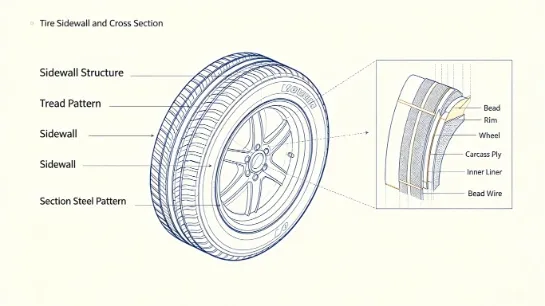
Complete size, safety and performance marks are printed on every tire sidewall. Overseas auto parts wholesalers, repair shops and end vehicle buyers often get confused by dimension codes, load capacity, speed ratings and global certification labels. This article breaks down all sidewall markings in plain language to help you match tires to vehicles quickly without complicated technical knowledge.
1. Full Explanation of Tire Size Numbers & Letters
Take the mainstream tire size 205/60 R15 91H as a step-by-step example:
- 205: Section width in millimeters, meaning the horizontal width of tire tread excluding raised patterns and letter prints;
- 60: Aspect ratio in percentage. Sidewall height = section width × 60%. Smaller aspect ratio number equals thinner sidewall;
- R: Abbreviation for Radial, representing radial tires. S stands for vintage bias tires; ZR for high-performance radial sports tires; prefix T indicates temporary spare tires;
- 15: Matching wheel rim diameter measured in inches;
- 91: Load index, corresponding to the maximum load capacity of a single tire;
- H: Speed rating, referring to the maximum safe driving speed permitted for the tire.
Example of sports tire size: 225/40 ZR18 92W ZR marks high-performance radial tires built for high-speed driving. Speed rating W allows a maximum safe speed of 270km/h, ideal for sports cars and performance sedans.
2. Driving Impacts of High & Low Aspect Ratios
- High Aspect Ratio (60, 65, 70 and larger figures) Thicker sidewalls deliver excellent shock absorption and smooth rides on paved city roads. The downside is vague road feedback and weak lateral support during high-speed turns, so they are widely used for daily commuter sedans.
- Low Aspect Ratio (30, 35, 40, 45 and smaller figures) Wider tread and thin sidewalls transmit clear road feedback with strong lateral rigidity for superior braking and high-speed handling. The drawback is stiff shock absorption with obvious road vibration and louder tire noise, mostly fitted for sports cars and modified vehicles.
3. Simplified Tire Speed Rating Guide
Letters on sidewalls indicate the maximum safe driving speed, critical reference for orders targeting regions with high-speed highways:
- B~G: 50-90km/h, low-speed tires for agricultural machinery and warehouse forklifts
- J~K: 100-110km/h, low-speed scooters and utility two-wheelers
- L~T: 120-190km/h, standard all-season tires for daily family cars
- U/H: 200/210km/h, mid-to-high end passenger sedans
- V: 240km/h, entry-level sports tires
- W: 270km/h & Y: 300km/h, high-performance sports cars and track modified tires
4. All Categories of Tire Sidewall Labels
Basic Product Information
Brand logo, full tire dimension, tread pattern series name, Radial mark, production week code (e.g. 1817 = manufactured in the 18th week of 2017)
Safety & Balance Marks
Rotation direction arrow, white dot dynamic balance marker, uniformity mark. These guide tire mounting alignment to avoid vehicle vibration at high speeds.
Global Safety Certification Marks
CCC (China Compulsory Certification), DOT (US Department of Transportation certification, mandatory for North America sales), ECE E-MARK (EU safety certification required for European exports), ECE noise certification label
UTQG Tire Quality Grades (Mandatory For North American Market)
- TREADWEAR: Tread wear index, higher numbers mean longer mileage (260/280/320 etc.)
- TRACTION: Wet grip grade ranging AA/A/B/C; AA delivers optimal wet road traction
- TEMPERATURE: Heat resistance grade A/B/C; A provides best high-temperature durability
Other Functional Marks
Tubeless label, ply material & layer count for tread/sidewall, 3T grade marks, air pressure & load parameters for regional markets, safety installation warning text
5. Quick Tire Sourcing Tips
- Replacement tires must strictly match original vehicle size; avoid drastic changes to section width, rim diameter and aspect ratio;
- Orders for North America need tires with DOT certification and complete UTQG grades; European shipments require valid E-MARK approval;
- High-speed vehicles should select tires with H/V/W/Y high speed ratings. Heavy-duty trucks need careful load index verification;
- Prioritize tires produced within 3 years. Rubber aging occurs after 5 years of storage, severely downgrading driving safety.